
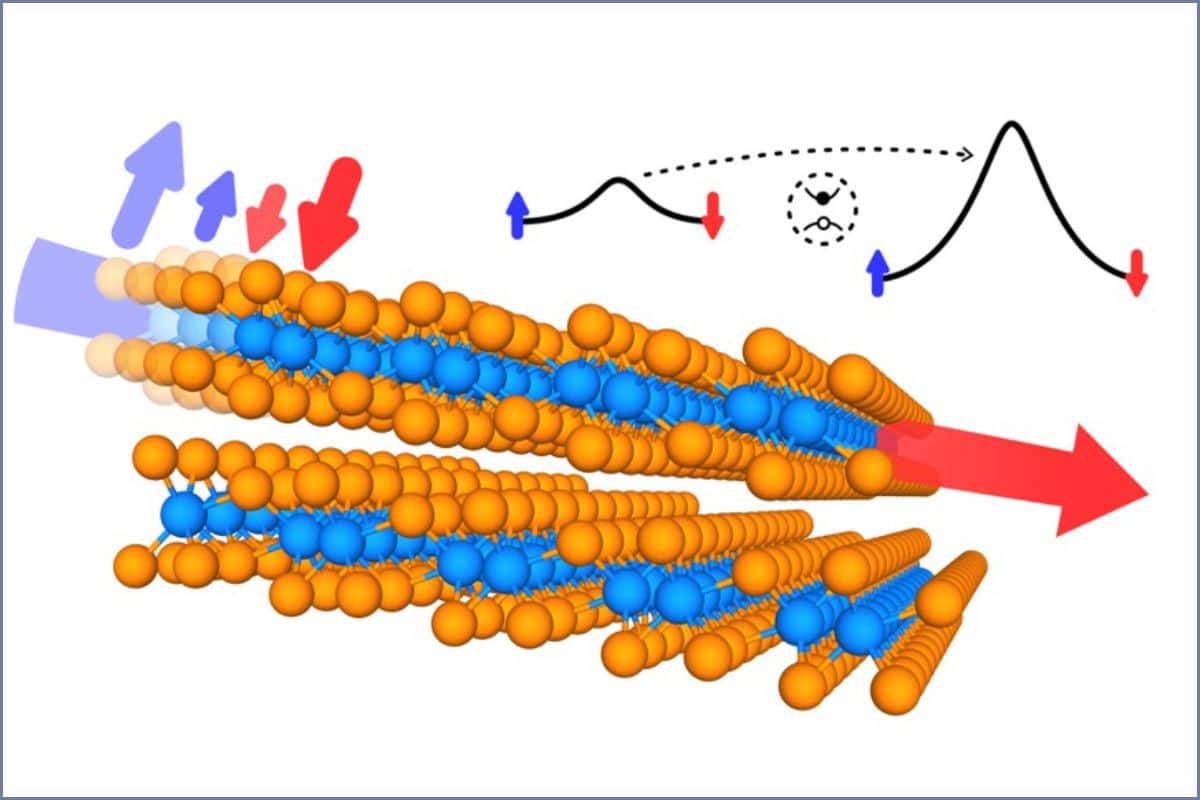
A new study carried out by Cnr Nano in collaboration with the Università di Modena and Reggio Emilia published in Nature Communications sheds light on a previously poorly understood aspect of sliding ferroelectricity in two-dimensional materials, an emerging phenomenon that enables faster and more energy-efficient electronic devices.
The study, authored by Massimo Rontani and Daniele Varsano (Cnr Nano) together with Elisa Molinari and Matteo D’Alessio (Unimore), addresses an open problem in the field of ferroelectricity — the property of certain materials to exhibit a spontaneous and reversible electric polarization whose direction can be switched by applying an electric field. This feature underpins technologies such as non-volatile memories and neuromorphic devices.
Recently, a new form of ferroelectricity, known as sliding ferroelectricity, has been observed in some two-dimensional materials where atomic layers are weekly bound by van der Waals interactions. In these systems, electric polarization arises directly from the way electronic charge is distributed between the atomic layers and can be reversed by sliding the layers between each other. “This property paves the way for faster and more efficient devices, because the energy required to switch polarization in a sliding ferroelectric is typically much lower compared to traditional ferroelectrics. In some specific devices, the entity of the energy barrier that separates the two states with opposite polarization, and therefore the stability of the sliding ferroelectric properties, was not completely understood”, explains Matteo D’Alessio, PhD student in Physics and Nanoscience at Unimore.
Researchers have now provided a theoretical explanation, showing that this stability is linked to the two-dimensional nature of the material, which enhances quantum effects. “The reduced dimensionality favours the formation of strongly bound excitons, which can lead to a collective behaviour of electrons. In the case of sliding ferroelectric semimetal, this collective behaviour both enhances the sliding energy barrier and makes the polarization more robust” adds Massimo Rontani. “This mechanism had not previously been considered in theoretical models and helps improve our understanding of ferroelectricity in these new materials with high application potential.”
The results indicate that the phenomenon could extend to a broad class of two-dimensional materials, opening new perspectives for the design of faster electronic devices with lower energy consumption that can be integrated into next-generation circuits.
The study combined advanced simulations based on ab initio calculations with specially developed theoretical models, using high-performance computing infrastructures. The activities are part of the quantum materials research carried out at Cnr Nano in Modena, with support from the European Centre of Excellence MaX (MAterials design at the eXascale) and ICSC – National Research Centre in High Performance Computing, Big Data and Quantum Computing.
Reference article: M. D’Alessio, D. Varsano, E. Molinari, M. Rontani. Stabilization of sliding ferroelectricity through exciton condensation. Nat Commun(2026). https://doi.org/10.1038/s41467-026-71890-2
[IMAGE: Schematic representation of the two-dimensional material WTe₂ and the sliding process between layers. The graphs show the energy barrier associated with polarization: higher when the collective quantum behavior of electrons is taken into account, lower when this effect is neglected]


