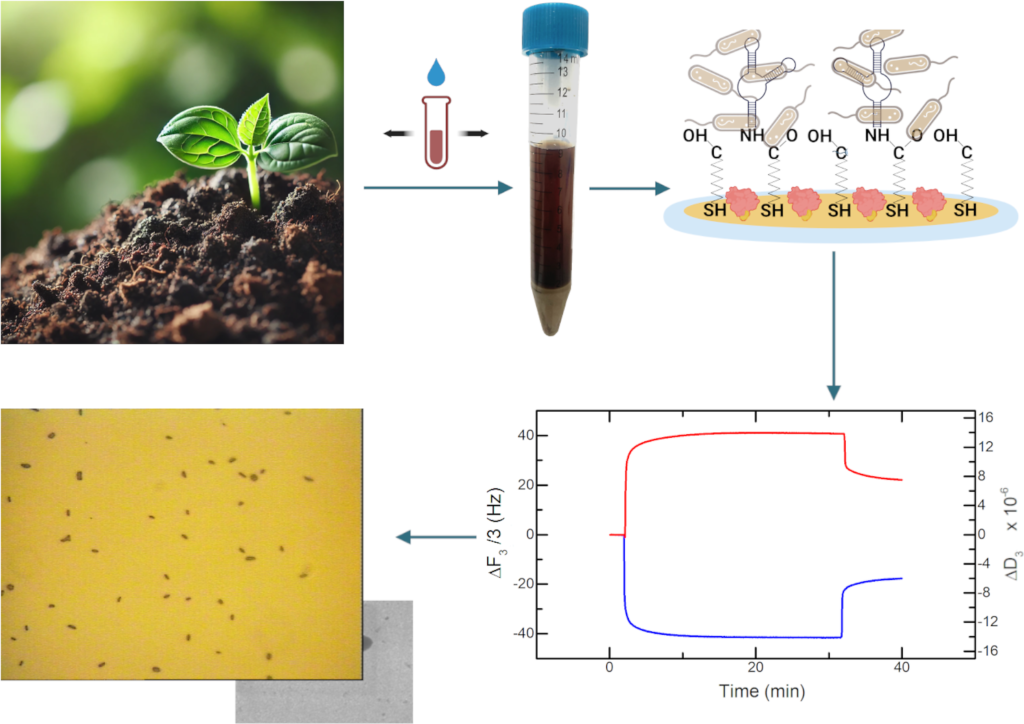


A research team led by Marco Cecchini at Cnr Nano, has developed a new sensor capable of detecting microbial biofertilizers directly in soil extracts. As the use of microbial inoculants grows in sustainable agriculture, rapid and reliable monitoring tools are increasingly needed to track their persistence and effectiveness in the field. Results are published in Microchemical Journal.
The research involved scientists from the CREA – Council for Agricultural Research and Economics (I), INTA System (I), the National Institute of Horticultural Research (PL), and NEST laboratory at Scuola Normale Superiore.
The new platform combines Quartz Crystal Microbalance with Dissipation (QCM-D) and highly selective DNA aptamers engineered to recognize Bacillus subtilis, one of the most widely used biofertilizer strains. The innovative sensor demonstrated excellent specificity, even in complex soils such as sandy soil from Poland (neutral pH) and sandy loam from Germany (sub-alkaline pH), achieving a detection limit between 105 and 106 CFU/ml.
“QCM-D analysis demonstrates significant specificity in both soils, as confirmed by triplicate experiments, supporting the aptasensor’s robustness and adaptability and potential for on-site monitoring of microbial inoculants in complex soil matrices”, says Cecchini. “This work lays the foundation for future portable, on-site devices that could help farmers, researchers, and regulatory agencies monitor microbial products quickly and reliably, supporting more sustainable agricultural practices”.
This research was performed under the EXCALIBUR project, funded by the European Union’s Horizon 2020 Research and Innovation Program (Grant Agreement No. 817946), and under the SPIN-FERT project, funded by the European ‘MISSION SOIL’ Innovation Action Program (Grant Agreement No. 101157265).
Reference article: Francesco Lunardelli, Andrea Manfredini, Loredana Canfora, Mariacristina Gagliardi, Matteo Agostini, Domenica Convertino, Stefano Mocali, Eligio Malusa, Marco Cecchini, Aptamer-based QCM-D platform for monitoring biofertilizers in soil, Microchemical Journal, Volume 219, 2025, 116112, DOI: https://doi.org/10.1016/j.microc.2025.116112
[Photo by Glen Carrie on Unsplash]



| Cookie | Duration | Description |
|---|---|---|
| cookielawinfo-checkbox-analytics | 11 months | This cookie is set by GDPR Cookie Consent plugin. The cookie is used to store the user consent for the cookies in the category "Analytics". |
| cookielawinfo-checkbox-functional | 11 months | The cookie is set by GDPR cookie consent to record the user consent for the cookies in the category "Functional". |
| cookielawinfo-checkbox-necessary | 11 months | This cookie is set by GDPR Cookie Consent plugin. The cookies is used to store the user consent for the cookies in the category "Necessary". |
| cookielawinfo-checkbox-others | 11 months | This cookie is set by GDPR Cookie Consent plugin. The cookie is used to store the user consent for the cookies in the category "Other. |
| cookielawinfo-checkbox-performance | 11 months | This cookie is set by GDPR Cookie Consent plugin. The cookie is used to store the user consent for the cookies in the category "Performance". |
| viewed_cookie_policy | 11 months | The cookie is set by the GDPR Cookie Consent plugin and is used to store whether or not user has consented to the use of cookies. It does not store any personal data. |