
Cnr Nano’s team realizes the first phase battery for quantum technologies
A classical battery converts chemical energy into a voltage bias that can power electronic circuits. Similarly, a phase battery is a quantum device that provides a persistent phase bias to the wave function of a quantum circuit. This key element for quantum technologies based on phase coherence as been demonstrated by Francesco Giazotto's groupand published in Nature Nanotechnology.

Batteries belongs to everyday life. A classical battery, the Volta´s pile, converts chemical energy into a voltage, which can power electronic circuits. In many quantum technologies, circuits or devices are based on superconducting materials. In such materials, currents may flow without the need of an applied voltage; therefore, there is no need for a classical battery in such a system. These currents are called supercurrents because they do not exhibit any energy losses. They are induced not from a voltage but from a phase difference of the wave function of the quantum circuit, which is directly related to the wave nature of matter. Such that a quantum device able to provide a persistent phase difference can be seen as a quantum phase battery, which induces supercurrents in a quantum circuit.


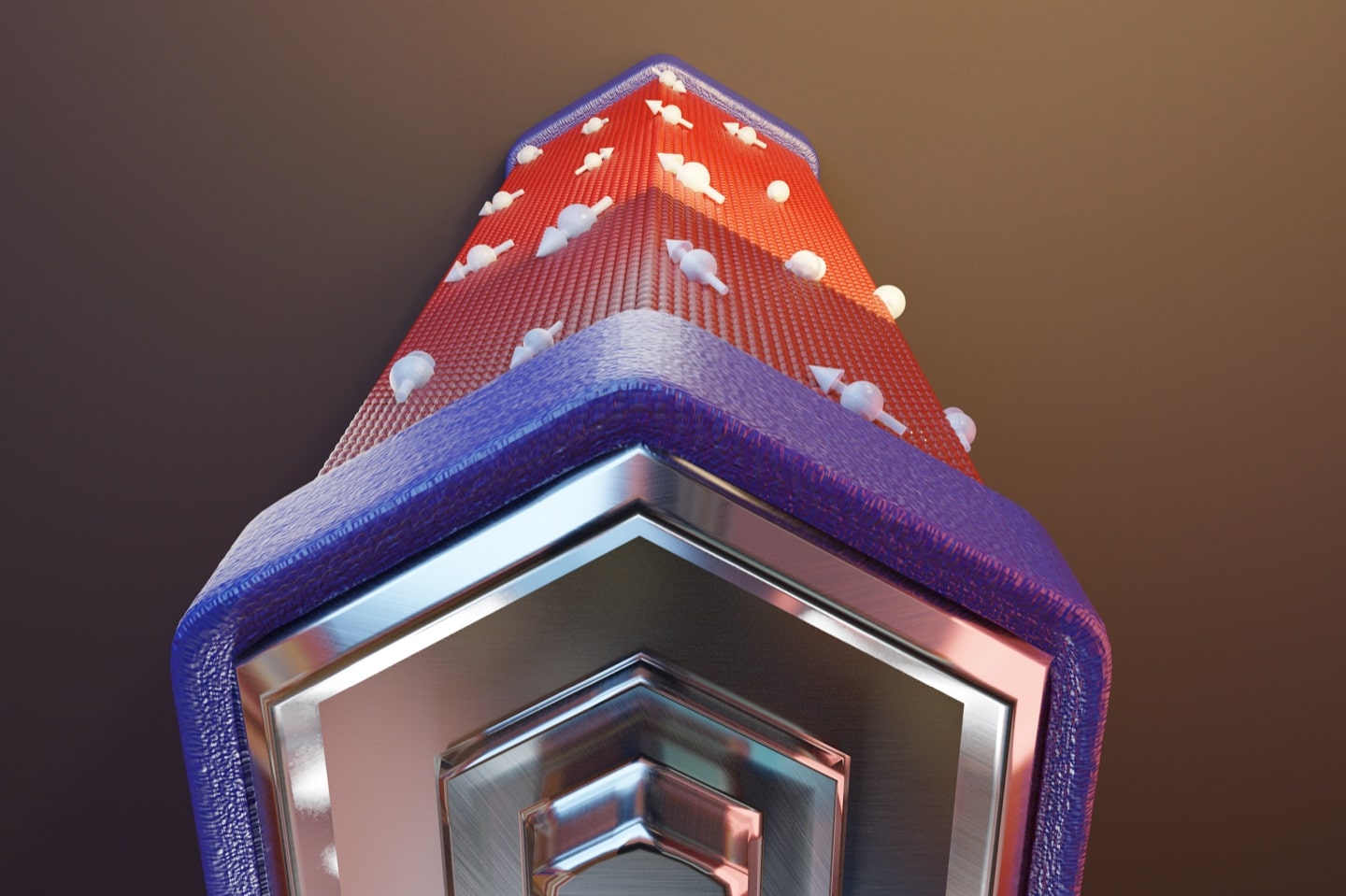
Now the first quantum phase battery has been realized by the research team of Francesco Giazotto from Cnr Nano based al the NEST laborarory of Scuola Normale Superore in Pisa and the group of  Sebastian Bergeret  from the Materials Physics Center-CFM in San Sebastian, with the collaboration of Salerno University. The device consist of an indium arsenide (InAs) nanowire in contact with aluminum superconducting leads and is a key element for quantum technologies based on phase coherence. The work has been published in the prestigious journal Nature Nanotechnology.


The result stems from a collaborative effort between Sebastian Bergeret, who in 2015 conceived the device from a theoretical point of view, and Francesco Giazotto and Elia Strambini (Cnr Nano), who identified a suitable material combination and fabricated the first quantum phase battery. "The core of the battery consists of an n-doped InAs nanowire forming the core of the battery (the pile) and Al superconducting leads as poles. The battery is charged by applying an external magnetic field, which then can be switched off", explains Strambini. "The choice of the materials was crucial", continues the researcher, "in fact, it is through the presence of oxides and defects on the nanowire surface that magnetic moments are generated and their polarization is efficiently converted into a persistent phase bias".


The quantum phase coherence measures were conducted by the CnrNano team, with ultra-cryogenic systems among the most advanced in the world based the the NEST lab in Pisa.


Elia Strambini, Andrea Iorio, Ofelia Durante, Roberta Citro, Cristina Sanz-Fernández, Claudio Guarcello, Ilya V. Tokatly, Alessandro Braggio, Mirko Rocci, Nadia Ligato, Valentina Zannier, Lucia Sorba, F. Sebastián Bergeret & Francesco Giazotto, A Josephson phase battery. Nat. Nanotechnol.15, 656–660 (2020). https://doi.org/10.1038/s41565-020-0712-7

Batteries belongs to everyday life. A classical battery, the Volta´s pile, converts chemical energy into a voltage, which can power electronic circuits. In many quantum technologies, circuits or devices are based on superconducting materials. In such materials, currents may flow without the need of an applied voltage; therefore, there is no need for a classical battery in such a system. These currents are called supercurrents because they do not exhibit any energy losses. They are induced not from a voltage but from a phase difference of the wave function of the quantum circuit, which is directly related to the wave nature of matter. Such that a quantum device able to provide a persistent phase difference can be seen as a quantum phase battery, which induces supercurrents in a quantum circuit.


Now the first quantum phase battery has been realized by the research team of Francesco Giazotto from Cnr Nano based al the NEST laborarory of Scuola Normale Superore in Pisa and the group of  Sebastian Bergeret  from the Materials Physics Center-CFM in San Sebastian, with the collaboration of Salerno University. The device consist of an indium arsenide (InAs) nanowire in contact with aluminum superconducting leads and is a key element for quantum technologies based on phase coherence. The work has been published in the prestigious journal Nature Nanotechnology.


The result stems from a collaborative effort between Sebastian Bergeret, who in 2015 conceived the device from a theoretical point of view, and Francesco Giazotto and Elia Strambini (Cnr Nano), who identified a suitable material combination and fabricated the first quantum phase battery. “The core of the battery consists of an n-doped InAs nanowire forming the core of the battery (the pile) and Al superconducting leads as poles. The battery is charged by applying an external magnetic field, which then can be switched off”, explains Strambini. “The choice of the materials was crucial”, continues the researcher, “in fact, it is through the presence of oxides and defects on the nanowire surface that magnetic moments are generated and their polarization is efficiently converted into a persistent phase bias”.


The quantum phase coherence measures were conducted by the CnrNano team, with ultra-cryogenic systems among the most advanced in the world based the the NEST lab in Pisa.


Elia Strambini, Andrea Iorio, Ofelia Durante, Roberta Citro, Cristina Sanz-Fernández, Claudio Guarcello, Ilya V. Tokatly, Alessandro Braggio, Mirko Rocci, Nadia Ligato, Valentina Zannier, Lucia Sorba, F. Sebastián Bergeret & Francesco Giazotto, A Josephson phase battery. Nat. Nanotechnol.15, 656–660 (2020). https://doi.org/10.1038/s41565-020-0712-7

Related Content

Graphene-Boosted laser breaks into the Terahertz forbidden band

Graphene-Boosted laser breaks into the Terahertz forbidden band

By leveraging graphene plasmonics and optical nonlinearity, Cnr Nano researchers extend semiconductor laser emission to 10 THz, reaching a frequency…
Cnr Nano at the European Researchers’ Night 2025: exploring nanoscience in Modena and Pisa

Cnr Nano at the European Researchers’ Night 2025: exploring nanoscience in Modena and Pisa

European Researchers’ Night is back – and so is our commitment. From the mysteries of quantum mechanics to advanced materials,…
ERC Advanced Grant awarded to Miriam Serena Vitiello for groundbreaking research in quantum photonics

ERC Advanced Grant awarded to Miriam Serena Vitiello for groundbreaking research in quantum photonics

The NODE project will develop compact solid-state laser sources by integrating semiconductor heterostructures and 2D quantum materials, enabling ultrafast light…