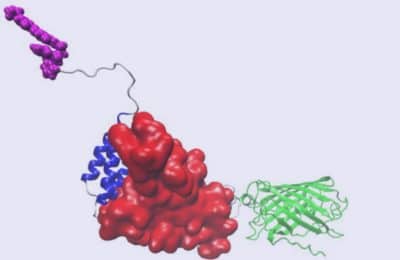
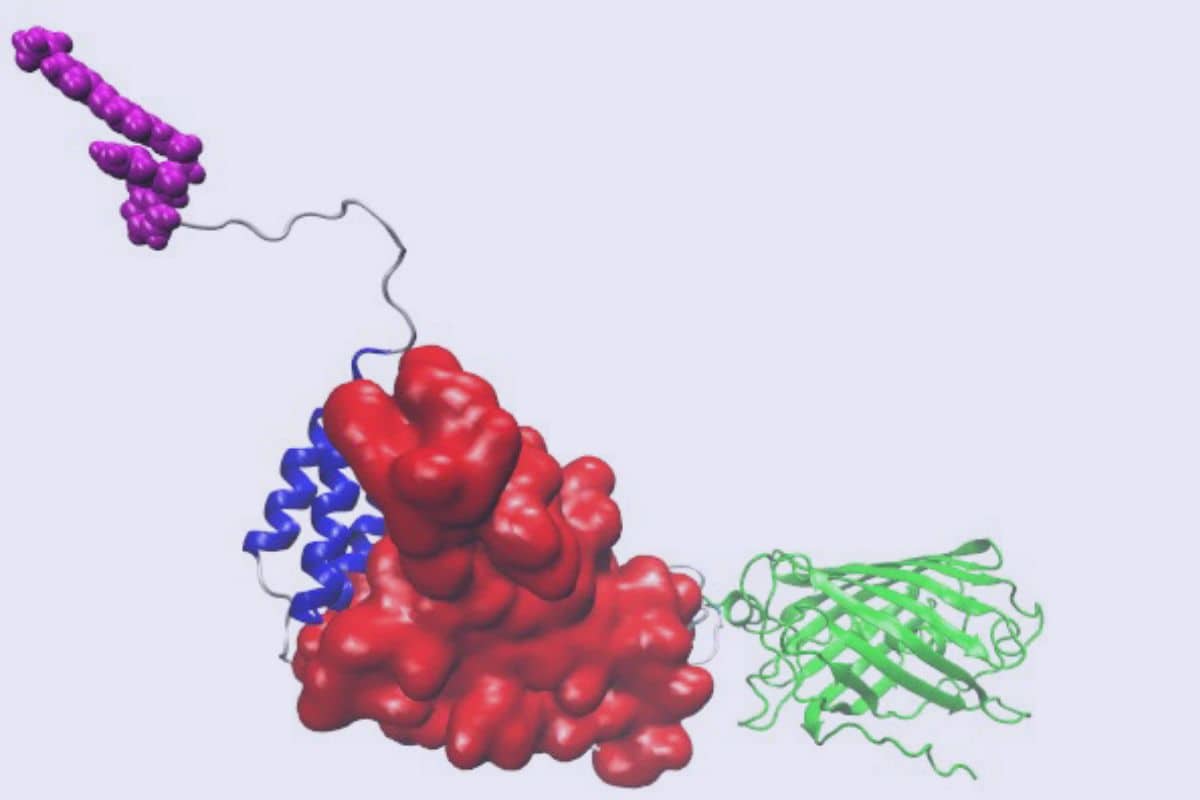
A team of researchers from Cnr Nano and the University of Pisa has developed a novel biosensor capable of detecting the Spike protein of SARS-CoV-2 in biological fluids with precision. This innovative tool is based on the Förster Resonance Energy Transfer (FRET) approach, a process widely used in molecular biology to study molecular interactions. It utilizes the unique fluorescence properties of Green Fluorescent Protein (GFP) to enable rapid and reliable viral detection. The study is published in the journal Nanoscale.
The sensor design integrates experimental research with molecular modeling and simulations, resulting in a modular architecture that allows for flexibility and adaptability in future developments. To refine the sensor’s design, the research team used molecular dynamics simulations to select specific linker components that balance flexibility and stability. One linker provided optimal structural conditions, while another minimized interference with the system’s interaction elements. These design choices contributed to the sensor’s performance and stability, both crucial for clinical applications.
The biosensor was successfully produced in E. coli bacteria, and its functionality was validated through experimental testing. Results demonstrated that the fluorescence response effectively correlated with Spike protein concentration, confirming its potential as a diagnostic tool.
“This FRET-based biosensor marks an important advancement in viral detection technologies. Its modular design not only facilitates the detection of SARS-CoV-2 but also provides a foundation for adapting to other viral targets,” explains Giorgia Brancolini from Cnr Nano, corresponding author of the study. “With further refinement, this proof-of-concept tool could contribute to improved diagnostic strategies in clinical settings, supporting more efficient disease monitoring and control”.
This research was carried out by Giorgia Brancolini, Valentina Tozzini, Barbara Storti, Ranieri Bizzarri, Daniele Montepietra, all from Cnr Nano, and Laura Marchetti, Eleonora Da Pozzo, Lorenzo Germelli, Elisa Angeloni, Chiara Giacomelli, Elisabetta Barresi, Sabrina Taliani, all from University of Pisa. The study was supported by the PRIN2020 project “Early Phase Preclinical Development of PACECOR, a Mutation-Independent Anti-SARS-CoV-2 Therapeutic Strategy”.
Original article: An intramolecular FRET biosensor for the detection of SARS-CoV-2 in biological fluids, Montepietra D, Germelli L, Marchetti L, Tozzini V, Angeloni E, Giacomelli C, Storti B, Bizzarri R, Barresi E, Taliani S, Brancolini G, Da Pozzo E. . Nanoscale. 2025 Mar 17. doi: 10.1039/d4nr05040a link: https://doi.org/10.1039/D4NR05040A