
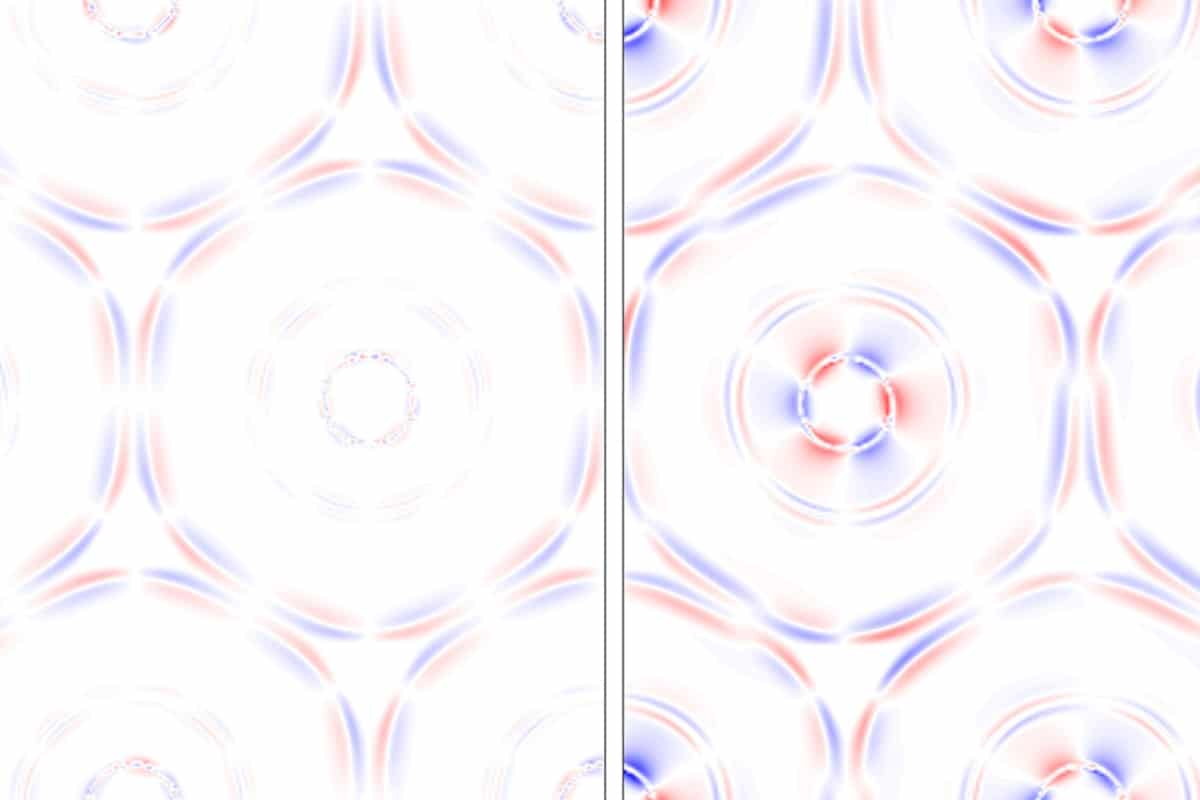
Accurately describing how electron spins evolve in magnetic materials is one of the modern key challenges in computational condensed-matter physics. In a study published in Physical Review Letters, Cnr Nano researcher and colleagues show how a long-standing theoretical inconsistency — the so-called spin-torque problem — can be resolved by accounting for fundamental symmetry principles within modern density-functional methods. The result provides a physically sound description of spin torques and enables more reliable simulations of spin dynamics in complex magnetic systems, with potential applications ranging from spintronics to quantum technologies.
The research was carried out through an international collaboration including Jacques Desmarais (Università di Torino), Kamel Bencheikh (Ferhat Abbas Sétif University), Giovanni Vignale (National University of Singapore), and Stefano Pittalis (Cnr Nano).
Electron spin can be viewed as a tiny intrinsic magnet whose orientation may change under the influence of magnetic fields, spin–orbit coupling, or electronic interactions. When spins are driven out of equilibrium, they experience spin torques: twisting forces that cause them to rotate or realign, much like a compass needle responding to an external field. Accurately capturing these effects is crucial for reliable simulations of magnetic materials and spintronic devices.
The most widely used framework for describing magnetism at the microscopic level, Spin Density Functional Theory (Spin-DFT), can capture spin polarization but cannot fully account for spin–orbit coupling and spin currents. As a result, it can generate unphysical, or spurious, spin torques — an issue recognized for decades that limits the predictive power of simulations.
“Spurious spin torques have long made simulations of spin dynamics difficult. Our work shows how to eliminate these effects by using an extended version of Spin-DFT that also respects fundamental symmetry conditions”, explains Pittalis. “Our method ensures that simulations reflect directly the physical behavior of the magnetization. This provides a solid foundation for studying spin dynamics in systems relevant to next-generation technologies, including ultra-fast memory and energy-efficient devices.”
The study combines theoretical developments in quantum many-body physics with practical computational implementations in the CRYSTAL code developed at the Department of Chemistry, University of Turin, Italy.
Reference article:
Physical Spin Torques from Exactly Constrained Exchange-Correlation Torques, J. K. Desmarais, K. Bencheikh, G. Vignale, and S. Pittalis, Physical Review Letters, published 7 January 2026. DOI: 10.1103/lt1f-8pz2