
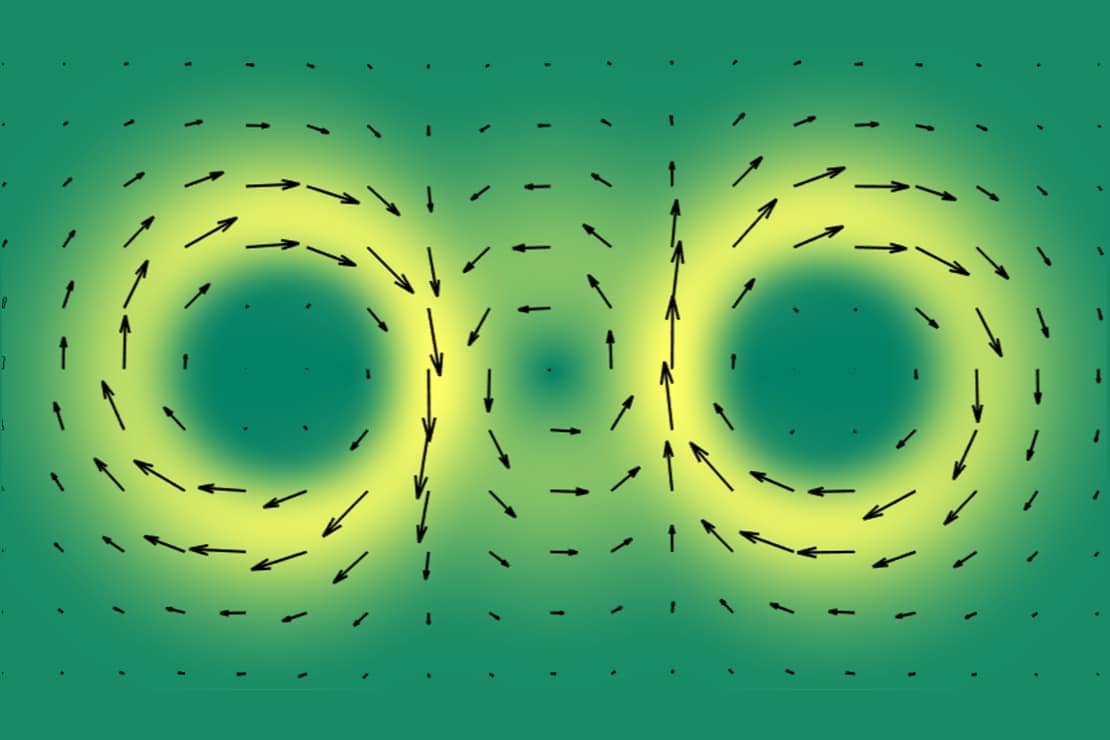
Einstein's theory of special relativity is renowned for predicting a range of mind-boggling phenomena, such as the paradox of twins aging at different rates when traveling at high speeds. What is less known is that special relativity also governs the behaviour of the materials around us. When electrons move at high velocities, they experience a remarkable interaction where their orbital motion becomes intertwined with their internal magnetic state. This phenomenon is known as spin-orbit coupling (SOC). Due to SOC it is possible for spin-currents to flow, transporting spin information instead of (only) electric charge.
A study by Cnr Nano researcher Stefano Pittalis in collaboration with University of Turin and National University of Singapore, extends the modeling of materials by including the description of spin-currents, solely based on first-principles of quantum mechanics. The simulations enabled by this work can contribute to the development of spintronic, leading to transport and storage of information at a low energy cost compared to traditional electronic technologies.
In their study just published in the journal PRL, Pittalis and colleagues determine how to account for the effect of the flow of the electron spins in models of materials.
The novelty of this work upgrades the core of Density Functional Theory (DFT), a computational method that balances accuracy and computational effort in simulating quantum materials. DFT simulations can reduce the need for costly or challenging experiments in understanding nanoscale phenomena. Central to DFT is the exchange-correlation energy, a functional of the charge density that accounts for the influence of electron interactions. Although the exact functional is well-defined, practical calculations require approximations such as the SCAN (strongly-constrained-appropriately-normed) functional, which is a successful modern approximation. However, in the presence of spin-orbit coupling (SOC), the exchange-correlation energy must account for spin currents, a a requirement missed by the original SCAN and other mainstream approximations.
Researchers introduced a non-empirical method to incorporate spin currents into SCAN and similar approximations. They achieved this goal by following the Gauge Principle, a fundamental yet fascinating concept in quantum mechanics. “Despite its complexity, this principle implies a straightforward fact: the exchange-correlation energy functional depends solely on the intrinsic physical properties of the state being examined, rather than on the specific representation used in various calculations. As a result, the inclusion of spin-currents in functionals like the SCAN can be determined unambiguously”, explains the researcher.
These findings will enable more accurate simulations for a host of materials that exhibit nontrivial properties which are related to spin orbit coupling and spin-currents. The interest in spin currents is justified by their potential use in technologies to move information with lower energy expenditure compared to traditional technologies that use electron charges.
The Gauge Principle expresses a very reasonable fact: the exchange-correlation energy functional depends solely on the intrinsic physical properties of the state being examined, rather than on the specific representation used in various calculations. As a result, the inclusion of spin-currents in the model is determined unambiguously.
Stefano Pittalis

Original paper:
"Spin-currents via the gauge-principle for meta-generalized-gradient exchange-correlation functionals", Jacques K. Desmarais, Jefferson Maul, Bartolomeo Civalleri, Alessandro Erba, Giovanni Vignale, and Stefano Pittalis, Phys. Rev. Lett. 132, 256401. https://journals.aps.org/prl/abstract/10.1103/PhysRevLett.132.256401


| Cookie | Duration | Description |
|---|---|---|
| cookielawinfo-checkbox-analytics | 11 months | This cookie is set by GDPR Cookie Consent plugin. The cookie is used to store the user consent for the cookies in the category "Analytics". |
| cookielawinfo-checkbox-functional | 11 months | The cookie is set by GDPR cookie consent to record the user consent for the cookies in the category "Functional". |
| cookielawinfo-checkbox-necessary | 11 months | This cookie is set by GDPR Cookie Consent plugin. The cookies is used to store the user consent for the cookies in the category "Necessary". |
| cookielawinfo-checkbox-others | 11 months | This cookie is set by GDPR Cookie Consent plugin. The cookie is used to store the user consent for the cookies in the category "Other. |
| cookielawinfo-checkbox-performance | 11 months | This cookie is set by GDPR Cookie Consent plugin. The cookie is used to store the user consent for the cookies in the category "Performance". |
| viewed_cookie_policy | 11 months | The cookie is set by the GDPR Cookie Consent plugin and is used to store whether or not user has consented to the use of cookies. It does not store any personal data. |