Optically-programmed ‘smart label’ based on nano-textured non-wovens fibers
Optical nanomaterials with photo-encoded thermal properties might establish new design rules for intelligent labels. A study by Cnr Nano, UniPisa and Scuola Normale Superiore.
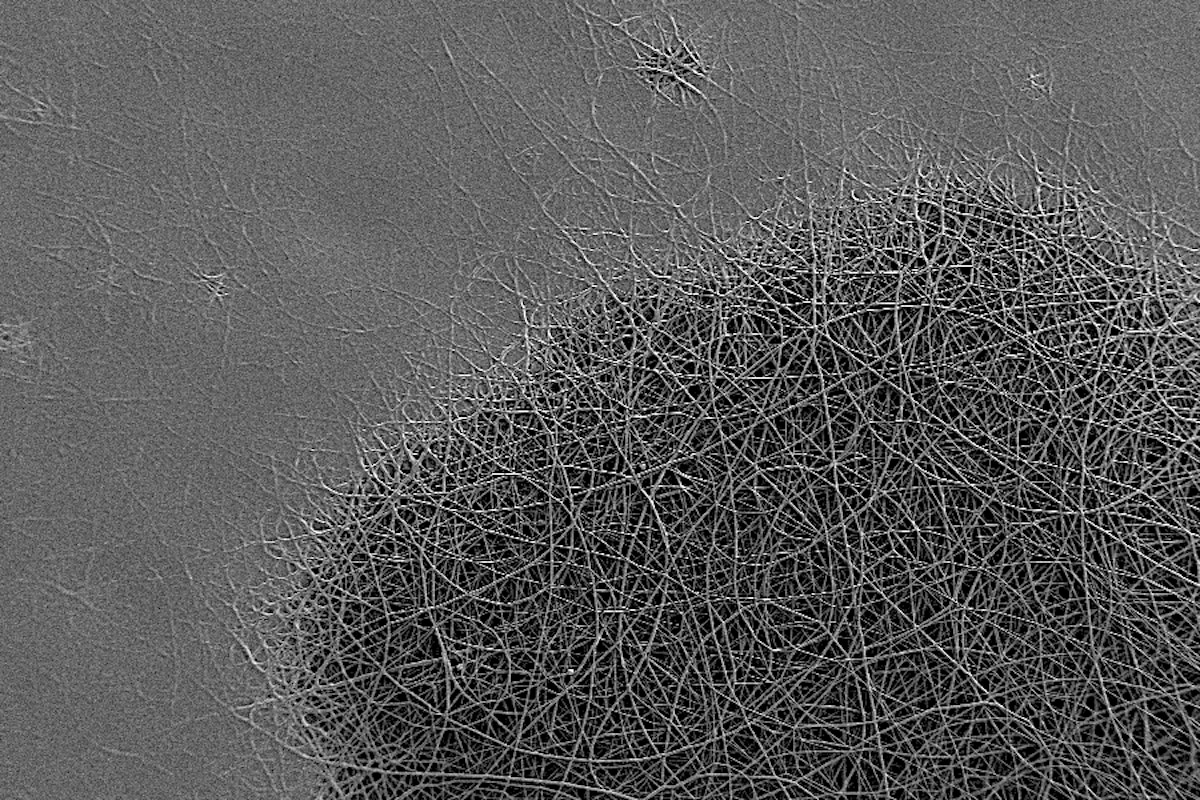
Detecting interruptions in the supply cold chain and exposure to inappropriate temperature are essential operations in the food or pharmaceutical sector. In the days of the development of a first anti Covid-19 vaccine, which must be stored and transported at 70 degrees below zero, the issue is in the spotlight. A possible answer to this problem comes from a research published in Nature Communications, coordinated by researchers from Cnr-NANO and the University of Pisa in collaboration with the Scuola Normale Superiore, Cnr-IPCF and the University of Messina. The team, coordinated by Luana Persano, researcher operating at the NEST Laboratory of Cnr-Nano and Scuola Normale Superiore, developed new nanomaterials with thermal properties that can be programmed using light. A result that would help to design smart labels for temperature monitoring. Researchers developed an optically-programmed, non-colorimetric indicators based on nano-textured non-wovens encoded by their cross-linking degree. This combination allows a desired time-temperature response to be achieved, to address different perishable products. The devices operate by visual contrast with ambient light, which is explained by backscattering calculations for the complex fibrous material. Optical nanomaterials with photo-encoded thermal properties might establish new design rules for intelligent labels. Romano, L., Portone, A., Coltelli, MB. et al. Intelligent non-colorimetric indicators for the perishable supply chain by non-wovens with photo-programmed thermal response. Nat Commun 11, 5991 (2020). https://doi.org/10.1038/s41467-020-19676-y
Detecting interruptions in the supply cold chain and exposure to inappropriate temperature are essential operations in the food or pharmaceutical sector. In the days of the development of a first anti Covid-19 vaccine, which must be stored and transported at 70 degrees below zero, the issue is in the spotlight.

A possible answer to this problem comes from a research published in Nature Communications, coordinated by researchers from Cnr-NANO and the University of Pisa in collaboration with the Scuola Normale Superiore, Cnr-IPCF and the University of Messina. The team, coordinated by Luana Persano, researcher operating at the NEST Laboratory of Cnr-Nano and Scuola Normale Superiore, developed new nanomaterials with thermal properties that can be programmed using light. A result that would help to design smart labels for temperature monitoring.

Researchers developed an optically-programmed, non-colorimetric indicators based on nano-textured non-wovens encoded by their cross-linking degree. This combination allows a desired time-temperature response to be achieved, to address different perishable products. The devices operate by visual contrast with ambient light, which is explained by backscattering calculations for the complex fibrous material. Optical nanomaterials with photo-encoded thermal properties might establish new design rules for intelligent labels.

Romano, L., Portone, A., Coltelli, MB. et al. Intelligent non-colorimetric indicators for the perishable supply chain by non-wovens with photo-programmed thermal response. Nat Commun 11, 5991 (2020). https://doi.org/10.1038/s41467-020-19676-y

Related Content

Graphene-Boosted laser breaks into the Terahertz forbidden band

Graphene-Boosted laser breaks into the Terahertz forbidden band

By leveraging graphene plasmonics and optical nonlinearity, Cnr Nano researchers extend semiconductor laser emission to 10 THz, reaching a frequency…
Cnr Nano at the European Researchers’ Night 2025: exploring nanoscience in Modena and Pisa

Cnr Nano at the European Researchers’ Night 2025: exploring nanoscience in Modena and Pisa

European Researchers’ Night is back – and so is our commitment. From the mysteries of quantum mechanics to advanced materials,…
ERC Advanced Grant awarded to Miriam Serena Vitiello for groundbreaking research in quantum photonics

ERC Advanced Grant awarded to Miriam Serena Vitiello for groundbreaking research in quantum photonics

The NODE project will develop compact solid-state laser sources by integrating semiconductor heterostructures and 2D quantum materials, enabling ultrafast light…