
Excitonic and topological order in T’-MoS2
Research team led by Cnr Nano studied the topological insulator MoS2, using advanced theoretical-computational methodologies based on quantum mechanics.
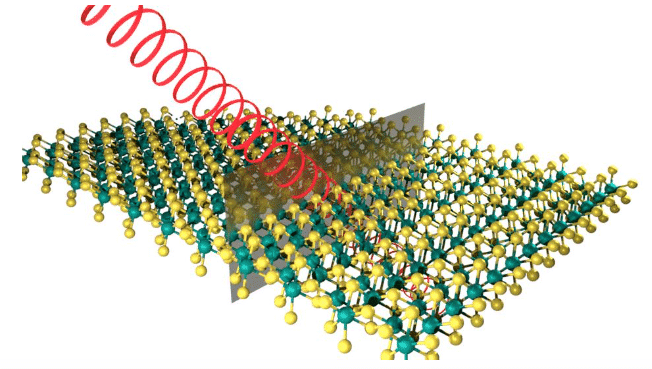
In an article just published on Nature Nanotechnology, our researchers Daniele Varsano, Elisa Molinari, and Massimo Rontani, in collaboration with Maurizia Palummo of the University of Rome Tor Vergata, studied the topological insulator MoS2, using advanced theoretical-computational methodologies based on quantum mechanics. By combining calculations from first principles with a self-consistent mean-field model, researchers showed that in the paradigmatic case of monolayer T' MoS2 the electronic dynamics in this material is more complex because the topological insulator also is an excitonic insulator. Researchers have shown that topological and excitonic properties coexist in a certain temperature and pressure range. They also showed how the electronic properties of MoS2 can be controlled through parameters such as temperature, pressure, or the presence of a substrate, making this results particularly interesting for the design of future nanoelectronics devices. The many-body perturbation theory calculations of the study were performed thanks to MaX CoE and PRACE. A monolayer transition-metal dichalcogenide as a topological excitonic insulator, Varsano, D., Palummo, M., Molinari, E. & Rontani M. Nature Nanotechnology (2020). https://doi.org/10.1038/s41565-020-0650-4 A free to read version can be found here: https://rdcu.be/b2phR

In an article just published on Nature Nanotechnology, our researchers Daniele Varsano, Elisa Molinari, and Massimo Rontani, in collaboration with Maurizia Palummo of the University of Rome Tor Vergata, studied the topological insulator MoS2, using advanced theoretical-computational methodologies based on quantum mechanics.


By combining calculations from first principles with a self-consistent mean-field model, researchers showed that in the paradigmatic case of monolayer T’ MoS2 the electronic dynamics in this material is more complex because the topological insulator also is an excitonic insulator. Researchers have shown that topological and excitonic properties coexist in a certain temperature and pressure range. They also showed how the electronic properties of MoS2 can be controlled through parameters such as temperature, pressure, or the presence of a substrate, making this results particularly interesting for the design of future nanoelectronics devices. The many-body perturbation theory calculations of the study were performed thanks to MaX CoE and PRACE.


A monolayer transition-metal dichalcogenide as a topological excitonic insulator, Varsano, D., Palummo, M., Molinari, E. & Rontani M. Nature Nanotechnology (2020). https://doi.org/10.1038/s41565-020-0650-4


A free to read version can be found here: https://rdcu.be/b2phR

Related Content

2nd Italian Glia Network Symposium: Cnr Nano among the organizers

2nd Italian Glia Network Symposium: Cnr Nano among the organizers

The online event brought together the Italian and international neuroscience community to discuss the emerging role of glial cells in…
Novel sensor enables direct detection of biofertilizers in soil

Novel sensor enables direct detection of biofertilizers in soil

Developed by Cnr Nano and CREA, the technology lays the groundwork for a rapid method to measure microbial biofertilizers directly…
Nanotechnology at the frontline of infectious disease research

Nanotechnology at the frontline of infectious disease research

Cnr Nano showcased nano-enabled solutions at the 3rd INF-ACT Annual Meeting, highlighting advanced approaches for rapid diagnostics and innovative therapeutic…