ERC grant to fund CnrNano project TERASEC
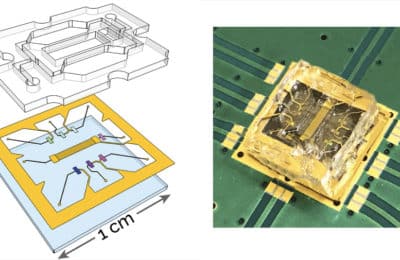
The EU-funded TERASEC project will deliver to the market a novel, incomparable security scanner device of unique performance. It fulfils all regulatory compliances. The scanner uses advanced and harmless THz waves thanks to superconducting and ferromagnetic materials that enable great sensitivity, fast response time and low noise-equivalent power.
Among the 76 top European researchers selected under the ERC Proof of Concept grants - third round 2019 - the ‘Terasec’ project proposed by Francesco Giazotto from Cnr Nano will develop an innovative device for the detection of security threats of European citizens and infrastructures. The researcher will receive a €150,000 grant to explore the innovation potential of its project and bring the results closer to market: the goal of the project is to deliver an unrivalled novel security scanner device leveraging harmless THz waves, that widely overpasses the accuracy performances of all the conventional systems, thus contributing to the safety of European citizens and the security of sensitive infrastructures. "The objectives of ‘Terasec’ project entail the activities aimed at pre-commercial validation of the technological performances and market potential of a novel device for the detection of security threats, such as weapons, explosives, drugs etc”, says Giazotto. The functionality of the system is enabled through combination of superconducting and ferromagnetic materials that delivers frequency selective THz sensors showing unprecedented sensitivity (single-photon resolution), fast response time, high dynamic range, and low noise-equivalent-power. “Specifically, starting from the outstanding outcomes reached so far, the capacity of the ‘Terasec’ system to detect the above threats with given level of accuracy, range and selectivity will be verified in accordance with the requirements of prospect users, to be collected during the project implementation. Moreover, a detailed market, IPR and regulatory compliance study will be carried out, in order to enable smooth implementation of ‘Terasec’ in the complicated context of the public security market. To enhance this, an advisory board gathering Key opinion leaders of the sector will be secured and involved into project activity throughout all the project duration. In parallel, comprehensive communication strategy addressing all the stakeholders of the relevant value chain will be rolled out, with strong focus on prospect consumers and users, so to ensuring market traction”. The total number of ERC Proof of Concept funded projects for 2019 is 200, with an overall budget of €30 million. 20 projects are from Italy: the grant provides the opportunity to enhance the time to market by investigating business opportunities, establishing intellectual property rights, and conducting technical validation for their frontier research findings. More info on the SQEL group website http://web.nano.cnr.it/sqel/

Among the 76 top European researchers selected under the ERC Proof of Concept grants – third round 2019 – the ‘Terasec’ project proposed by Francesco Giazotto from Cnr Nano will develop an innovative device for the detection of security threats of European citizens and infrastructures.

The researcher will receive a €150,000 grant to explore the innovation potential of its project and bring the results closer to market: the goal of the project is to deliver an unrivalled novel security scanner device leveraging harmless THz waves, that widely overpasses the accuracy performances of all the conventional systems, thus contributing to the safety of European citizens and the security of sensitive infrastructures.

“The objectives of ‘Terasec’ project entail the activities aimed at pre-commercial validation of the technological performances and market potential of a novel device for the detection of security threats, such as weapons, explosives, drugs etc”, says Giazotto.

The functionality of the system is enabled through combination of superconducting and ferromagnetic materials that delivers frequency selective THz sensors showing unprecedented sensitivity (single-photon resolution), fast response time, high dynamic range, and low noise-equivalent-power.

“Specifically, starting from the outstanding outcomes reached so far, the capacity of the ‘Terasec’ system to detect the above threats with given level of accuracy, range and selectivity will be verified in accordance with the requirements of prospect users, to be collected during the project implementation. Moreover, a detailed market, IPR and regulatory compliance study will be carried out, in order to enable smooth implementation of ‘Terasec’ in the complicated context of the public security market. To enhance this, an advisory board gathering Key opinion leaders of the sector will be secured and involved into project activity throughout all the project duration. In parallel, comprehensive communication strategy addressing all the stakeholders of the relevant value chain will be rolled out, with strong focus on prospect consumers and users, so to ensuring market traction”.

The total number of ERC Proof of Concept funded projects for 2019 is 200, with an overall budget of €30 million. 20 projects are from Italy: the grant provides the opportunity to enhance the time to market by investigating business opportunities, establishing intellectual property rights, and conducting technical validation for their frontier research findings.


More info on the SQEL group website http://web.nano.cnr.it/sqel/

Related Content

Cnr Nano joins MaterialsCommons, the new European federated digital infrastructure for materials research

Cnr Nano joins MaterialsCommons, the new European federated digital infrastructure for materials research

The Horizon Europe project brings together 26 research institutions from 14 countries and more than 30 industrial partners to create…
Innovative GFP-based sensor paves the way for rapid virus detection in clinical settings

Innovative GFP-based sensor paves the way for rapid virus detection in clinical settings

Cnr Nano team developed a FRET-based sensor that detects the SARS-CoV-2 Spike protein in biological fluids, leveraging GFP fluorescence and…
A coin-sized device to detect measles virus in saliva

A coin-sized device to detect measles virus in saliva

The new lab-on-a-chip is based on surface-acoustic-wave technology and is capable of detecting measles virions in human saliva. Results, published…