The study of out-of-equilibrium interacting systems, both theoretically and experimentally, is one of the greatest challenges in contemporary physics. Thermal equilibration processes play a fundamental role in the development of quantum technologies such as quantum computation, ultra-precise sensors and/or quantum simulations.
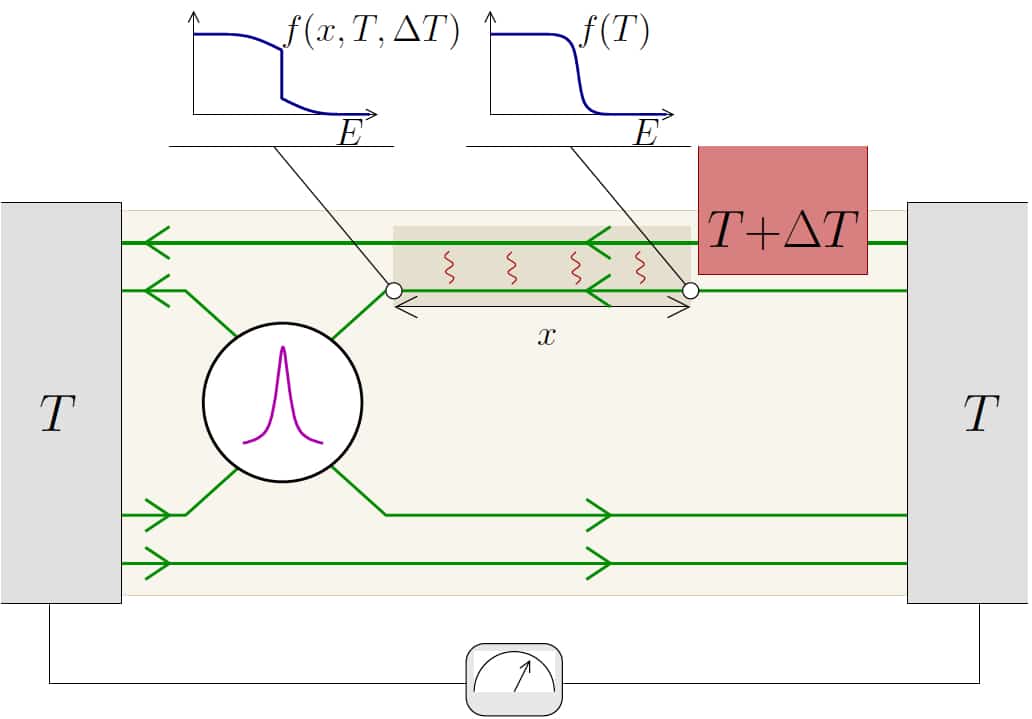
A team of researchers at Cnr Nano has studied how the process of thermal equilibration is realised in one-dimensional interacting systems such as the edge states of a quantum Hall system. The team showed how thermal relaxation between edge states, initially at different temperatures, evolves in terms of the interaction strength, the length of the interaction region and the temperature differences, finding a universal behaviour. The study is published on the Physical Review Research journal, with the title:
Nonlocal thermoelectric detection of interaction and correlations in edge states.
"The work also presents a realistic experimental scheme for verifying predictions by using nonlocal thermoelectricity as a heat current detector. This is a way of smartly solving the problem of measuring thermal currents by converting them, using thermoelectricity, into an easy-to-measure electric current," explains
Alessandro Braggio of Cnr Nano, author of the study together with Matteo Carrega from Cnr Spin Institute, Björn Sothmann from Universität Duisburg-Essen, and Rafael Sánchez from Universidad Autónoma de Madrid.
The study also shows how thermoelectric phenomena can be effectively used to measure heat exchange phenomena in complex systems.
Understanding thermal equilibration processes in interacting systems can have interesting spin-offs in the field of quantum technologies, if for example one considers that the realisation of the quantum computer presents, like the classical computer, problems in heat dissipation; or in the field of ultra-precise sensors for which heat represents an almost inevitable source of noise. The possibility then of having a computable theoretical model of relaxation processes in an interacting system represents a useful theoretical advancement for the theory of interacting systems out of equilibrium for which thermodynamics can hardly be fully described.
The theoretical research developed is part of the research related to quantum thermodynamics and strongly correlated systems carried out at Cnr Nano in the theoretical group formed by Alessandro Braggio and Fabio Taddei, in collaboration with Prof. Vittorio Giovannetti (Scuola Normale and Cnr Nano associate).
[Figure: Non-local thermoelectricity detects the energy exchange in a nonequilibrium interacting system formed by two integer quantum Hall channels. The inset shows the evolution of the electron distribution due to the heat exchange between the hot and cold channels]
Original publication
Alessandro Braggio, Matteo Carrega, Björn Sothmann, and Rafael Sánchez,
Nonlocal thermoelectric detection of interaction and correlations in edge states. Phys. Rev. Research
6, L012049
DOI:
https://doi.org/10.1103/PhysRevResearch.6.L012049