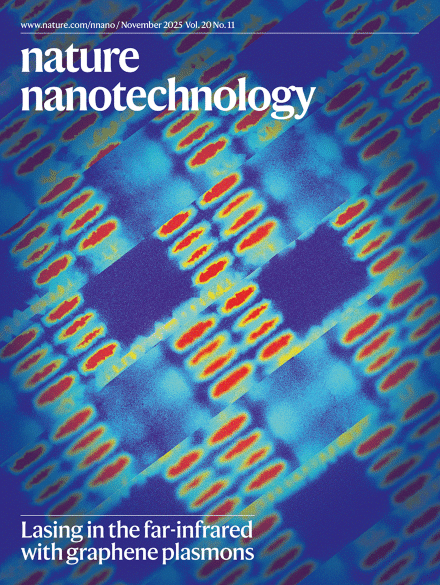

Researchers at Cnr Nano have demonstrated the first compact semiconductor laser capable of emitting light up to 10 terahertz, a frequency range long considered inaccessible. They achieved this by integrating a graphene micro-ribbon grating and harnessing plasmons and optical nonlinearity to lift the laser emission into the elusive far-end of the terahertz region. The breakthrough is published in Nature Nanotechnology, which features the work on its November cover.
Overcoming the long-standing ‘missing band’
Quantum cascade lasers (QCLs) are the most promising compact sources of terahertz radiation, yet they face a critical limitation: in the 6–12 THz range, gallium-arsenide-based devices strongly absorb light rather than amplifying it, preventing laser to operate.
This “missing band” – named Reststrahlenband – has hindered the development of coherent and compact sources for spectroscopy, sensing, communications, and astronomy, where access to high-frequency terahertz light is essential.
A graphene micro-grating that reshapes the electromagnetic field
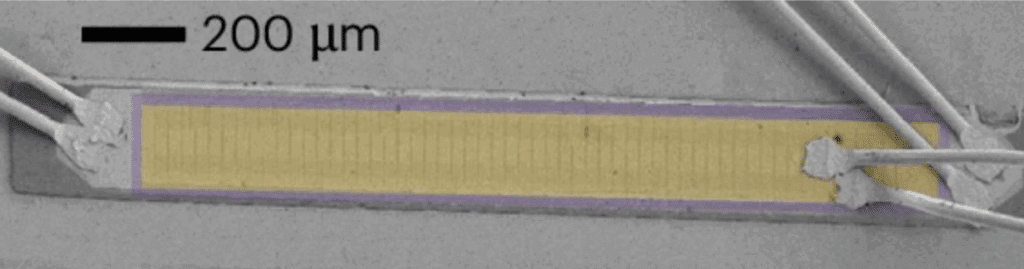
Now Miriam Serena Vitiello (research lead) and Alessandra Di Gaspare overcame this barrier by embedding a multilayer graphene micro-ribbon grating on top of a surface-emitting QCL. The graphene grating couples to the near-field of the cavity and strongly enhances the local electric field, triggering third-harmonic generation within the laser itself. As a result, radiation normally emitted at 3.3 THz is efficiently up-converted to frequencies around 9–10 THz, entering the previously inaccessible region.
An optical “launchpad” and a triple jump
“Simply put, the laser light ‘pushes itself’ to three times its original frequency, reaching the 10 THz region beyond the intrinsic limits of semiconductor materials. It’s like using graphene as a ‘springboard’ to propel light beyond its natural limit”, explains Vitiello. “The key mechanism relies on graphene’s extraordinary ability to confine and amplify electric fields at the nanoscale, giving rise to plasmons—collective oscillations of electrons that greatly enhance nonlinear optical effects. This allows frequency conversion even in extremely small volumes, without the need for complex phase-matching conditions between co-propagating waves.”
A first step toward broadband, tunable terahertz sources
Although the output power of this first prototype remains modest, it is already sufficient for for highly sensitive techniques such as atmospheric spectroscopy, astronomical instrumentation, and precision sensing.
Moreover, the method opens a new route toward compact, tunable terahertz sources capable of covering the entire 1.2–12 THz range.
Unlike approaches relying on external nonlinear crystals or bulky frequency-conversion stages, the graphene integration is on-chip, scalable, and compatible with standard QCL architectures.
The device was designed, fabricated, and tested at Cnr Nano (Pisa) within the NEST Laboratory of the Scuola Normale Superiore, where Vitiello leads the THz Photonics research group. The University of Leeds provided the high-quality semiconductor heterostructures, while the Cambridge Graphene Centre supplied the monolayer graphene used to define the plasmonic micro-grating.
The project is supported by the EXTREME-IR programme under the EU Horizon 2020 framework.
Reference article: Alessandra Di Gaspare, Sara Ghayeb-Zamharir, Lianhe Li, Edmund H. Linfield, Alexander G. Davies, Jincan Zhang, Osman Balci, Andrea C. Ferrari & Miriam S. Vitiello, Electrically driven heterostructured far-infrared wire lasers with integrated graphene plasmons. Nat. Nanotechnol. 20, 1611–1617 (2025). https://doi.org/10.1038/s41565-025-02005-z